You spend weeks translating your top-performing English articles into Arabic, publish them on your localized domain, and wait for the traffic to roll in. Months later, your analytics show almost zero organic impressions from MENA searchers. The problem is simple: translated content rarely matches how native Arabic speakers actually search, read, or evaluate trust online.
To succeed with Arabic SEO content, you must build articles from the ground up using native keyword research, morphological awareness, right-to-left (RTL) visual formatting, and culturally relevant examples. While search engines and AI discovery platforms like ChatGPT, Gemini, and Google AI Mode can surface well-structured Arabic pages, visibility requires native linguistic precision combined with strict human editorial review.
Key Takeaways for Arabic Content Teams
- Abandon direct translation: English search queries rarely map one-to-one with Arabic search behavior; always start with native keyword research in your target region.
- Choose the right register: Use Modern Standard Arabic (Fusha) for informational guides and B2B topics, and reserve local dialects for hyper-local campaigns or social commerce.
- Account for morphology: Arabic prefixes, suffixes, and plural forms alter how keywords appear, requiring semantic coverage rather than exact-match repetition.
- Design for RTL scanning: Right-to-left layouts need tailored typography, larger font sizes, and clear heading hierarchies to prevent high bounce rates.
- Combine AI speed with human verification: Use platforms like AiQalam to generate structured SEO briefs and drafts, then rely on native editors to verify facts, tone, and regional accuracy before publishing.
Why Direct Translation Fails in Arabic Search Markets
Many global marketing teams treat Arabic as a post-production translation task. They hand an English blog post to a translator, swap the page direction to right-to-left, and hit publish. This approach fails because search intent is deeply tied to culture, local regulations, and native phrasing.
When an English speaker searches for software or services, they often use compact noun phrases. An Arabic speaker looking for the exact same solution may phrase the query as a full question, use an explanatory phrase, or even mix English brand terms with Arabic descriptors. A literal word-for-word translation misses these high-intent search patterns entirely.
Furthermore, Arabic is a rich, root-based language where prefixes (such as conjunctions and prepositions) attach directly to the core noun. Search engines process these variations differently than English words separated by spaces. If your content uses stiff, translated phrasing, both human readers and automated discovery systems will recognize the lack of native authority.
Choosing Between Modern Standard Arabic and Local Dialects
Before writing a single word, you must decide which linguistic register fits your audience. Arabic is not a monolith; the way someone speaks in Riyadh differs noticeably from Cairo, Casablanca, or Dubai. However, written search behavior follows predictable patterns across the MENA region.
For the vast majority of informational blog posts, B2B software guides, healthcare resources, and financial explainers, Modern Standard Arabic (MSA or Fusha) is the gold standard. It is universally understood across all Arabic-speaking countries, carries professional authority, and aligns with how users type formal queries into search bars and AI chat interfaces.
| Content Register | Best Use Cases | SEO Search Volume Profile | Editorial Considerations |
|---|---|---|---|
| Modern Standard Arabic (MSA / Fusha) | Long-form blog posts, B2B guides, pillar pages, educational resources, medical and legal content | High across all MENA countries; captures formal and research-oriented queries | Keep sentences accessible and modern; avoid overly archaic or poetic vocabulary |
| Gulf / Khaleeji Dialect | Local service landing pages in KSA/UAE, hospitality, consumer retail promotions | Moderate to low for informational blogs; higher for conversational voice queries | Requires native regional review to avoid misusing local idioms |
| Egyptian Dialect | Consumer apps, entertainment, local e-commerce targeting Egypt specifically | High within Egypt for everyday consumer topics; low outside the country | Can feel informal; only use if brand voice is distinctly casual and local |
| Franco-Arabic / Transliterated Terms | Tech tutorials, gaming, software comparisons where English terms dominate | Niche; users often combine Arabic script with English acronyms (e.g., CRM, SEO) | Include both the Arabic script explanation and the common English acronym |
Step-by-Step Workflow for Creating Arabic SEO Content
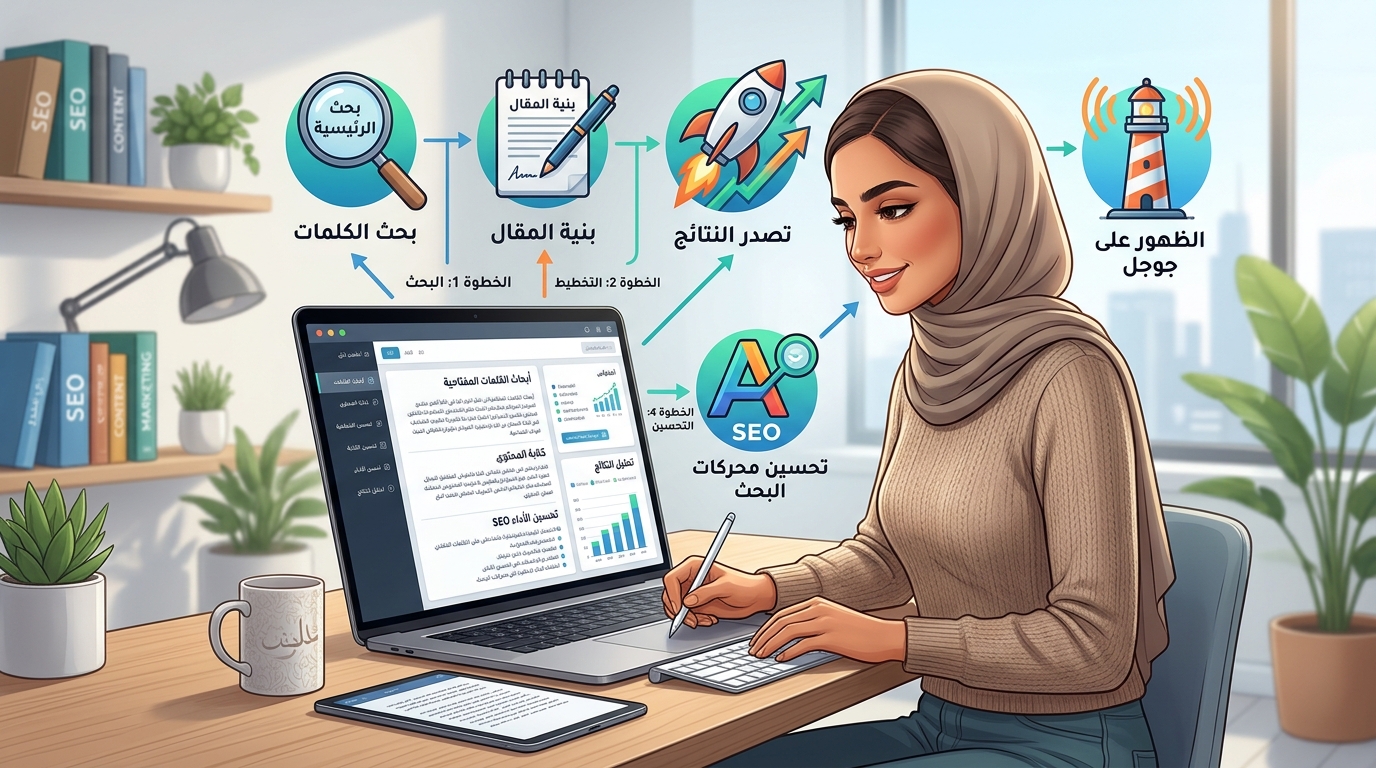
Building a repeatable content engine requires a structured workflow that bridges SEO data with native writing quality. Follow this five-step process to produce articles that serve both readers and search engines.
Step 1: Native Keyword and Intent Research
Start by brainstorming seed topics with a native speaker rather than plugging English keywords into a translation tool. Identify how customers describe their pain points in customer support tickets, sales calls, and regional forums. Look at search autocomplete suggestions in your target country (for example, setting your location to Saudi Arabia or Egypt) to see the exact phrasing users prefer.
Pay close attention to morphological variations. In Arabic, a single keyword concept might be searched with the definite article attached, without the definite article, in broken plural form, or paired with different prepositions. Group these close variants into a single topic cluster rather than creating separate thin pages for each spelling variation.
Step 2: Building a Localized SEO Brief
An effective SEO brief prevents writers from wandering off-topic and ensures comprehensive coverage. Your brief should define the primary search intent, target country or region, required heading structure (H2s and H3s), semantic subtopics to cover, and internal linking targets.
Instead of manually compiling outlines from scratch, teams can use AiQalam to generate structured SEO briefs tailored for Arabic or English workflows. Once the brief is generated, a strategist should review the outline to ensure it addresses region-specific context—such as local payment methods, regional compliance rules, or climate considerations—before drafting begins.
Step 3: Drafting for Clarity and Semantic Depth
When writing the draft, prioritize clarity and directness. Traditional Arabic prose sometimes favors long, winding paragraphs with elaborate introductions before reaching the main point. Online readers, however, scan quickly and expect immediate answers.
Open your article by stating the reader's problem and delivering the core answer within the first two paragraphs. Use clear transition words, break complex ideas into bulleted lists, and naturally weave semantic variations of your primary topic throughout the subheadings and body text. If a technical term has no widely accepted Arabic equivalent, write the Arabic explanation first and include the common English term or acronym in parentheses where helpful.
Step 4: Optimizing On-Page Elements and Metadata
Your meta title and meta description are your storefront in search results. Because Arabic characters take up different pixel widths than Latin characters, test your titles carefully so they do not truncate awkwardly on mobile screens.
For URL slugs, use clean, concise descriptors. While modern search engines handle Arabic script in URLs, encoded Arabic characters often copy and paste as long strings of percent signs and numbers when shared on social media or messaging apps. Discuss with your technical SEO team whether transliterated Latin slugs, clean English category slugs, or native Arabic slugs best fit your site architecture, and stay consistent across the domain.
Step 5: Visual Formatting for Right-to-Left (RTL) Readability
Even the best writing will fail if the page layout fights the reader. Ensure your content management system applies proper RTL attributes (`dir="rtl"`) to the article container, lists, and tables. Bullet points should sit on the right side of the text, and table columns should progress from right to left.
Typography is equally critical. Many default web fonts render Arabic script too small or cramped. Choose a modern, highly legible Arabic web font (such as Cairo, Tajawal, or Almarai), increase the base line height slightly compared to English stylesheets, and keep paragraphs under four lines to maintain visual breathing room. Pair your text with relevant featured images—which you can generate directly inside AiQalam—ensuring any visual directional cues make sense in an RTL layout.
Concrete Examples: Sample Inputs and Outputs
To see how this workflow operates in practice, review the following hypothetical example comparing a flawed translation approach against a native Arabic SEO approach (represented in English for clarity).
Hypothetical Example: B2B Accounting Software Guide
- Flawed Input (Direct Translation Mindset): Take an English article titled "How to Automate Tax Filing for Small Businesses" targeting US tax codes, translate it word-for-word into Arabic, and publish it for a Gulf audience.
- Why It Fails: The translated article references US-specific forms, uses literal translations for software features that sound robotic, and misses high-intent regional terms like Zakat and VAT compliance requirements in GCC countries.
- Correct Input (Localized Brief in AiQalam): Topic: Cloud accounting software for SMEs in Saudi Arabia. Primary Intent: Explaining how to manage electronic invoicing (Fatoomi/ZATCA concepts) and VAT calculation efficiently. Register: Accessible Modern Standard Arabic.
- Resulting Output Structure:
- Opening Hook: Addresses the exact challenge of manual invoice reconciliation under regional e-invoicing rules, followed by a direct explanation of how cloud automation solves it.
- H2 Breakdown: Sections covering core accounting features, step-by-step setup for tax calculation, data security standards, and a comparison table of implementation steps.
- Terminology Balance: Uses natural Arabic business terminology alongside widely searched acronyms where appropriate, reviewed by a local editor for factual accuracy.
Optimizing for Search Engines and AI Discovery
Modern search behavior extends beyond traditional ten-blue-link results. Users across the MENA region increasingly ask complex questions in ChatGPT, Google Gemini, and Google AI Mode to compare solutions, summarize regulations, and troubleshoot problems in Arabic.
While no tool or strategy can guarantee rankings, traffic, or automatic inclusion in AI responses, structuring your content clearly improves its discoverability across both traditional search and generative platforms. Focus on these core structural habits:
- Answer questions directly under headings: When an H2 or H3 asks a question, provide a concise, self-contained answer in the very first sentence following the heading before expanding into nuances.
- Use structured HTML elements: Format comparisons as clean `
` elements and step-by-step instructions as `
- ` or `
- Maintain strict factual consistency: Generative systems cross-reference claims across multiple sources. Avoid vague hyperbole, unverified statistics, or contradictory statements within your article.
- ` lists. Automated parsers extract structured HTML far more reliably than dense walls of text.
Common Mistakes That Sabotage Arabic SEO Content
Even experienced marketing teams fall into predictable traps when scaling content production. Watch out for these frequent errors:
- Ignoring Hamzas and Taa Marbuta consistency: In Arabic search, users frequently type Alef without a Hamza (ا instead of أ or إ) or swap Taa Marbuta (ة) with Haa (ه) at the end of words. While search engines are smart enough to bridge many of these gaps, your published content should adhere to proper grammatical spelling so it looks credible and authoritative to readers.
- Stuffing exact-match keywords unnaturally: Repeating the exact same noun phrase ten times in a short article destroys readability in Arabic. Use natural pronouns, root variations, and synonyms while keeping the core topic clear in your headings.
- Leaving LTR artifacts in RTL templates: Nothing screams "low-effort translation" faster than left-aligned subheadings, parentheses that flip backward around English acronyms, or quotation marks facing the wrong direction.
- Publishing unverified AI drafts: AI writing tools accelerate drafting, but publishing raw outputs without human oversight can introduce awkward phrasing, hallucinated regulations, or culturally tone-deaf examples.
- Forgetting internal link anchor text variety: Linking every article back to your homepage using generic words like "click here" wastes valuable contextual signals. Use descriptive, natural Arabic anchor phrases that describe the destination page.
Editorial Verification Checklist Before Publishing
Before moving any article from draft to published status in your workflow, run it through this mandatory human verification checklist:
- Intent Alignment: Does the opening paragraph directly solve the problem implied by the primary Arabic keyword within the first 100 words?
- Linguistic Flow: Read the article aloud. Does the Modern Standard Arabic sound natural, modern, and clear, free of clunky translated sentence structures?
- Fact and Claim Verification: Has a human editor verified every regulation, price format, regional reference, and technical claim? (Never rely on automated generation to verify real-world facts.)
- Heading Hierarchy: Are H2 and H3 tags used logically to break up the guide, with paragraphs kept under 3–4 lines for mobile readability?
- Bidirectional Text Check: If the article contains English brand names, numbers, or acronyms mixed into Arabic sentences, do they render in the correct reading order on both desktop and mobile views?
- Visual and Media Check: Is the featured image culturally appropriate, properly compressed, and accompanied by descriptive Arabic alt text?
- Metadata Review: Are the meta title (50–60 characters) and meta description (140–160 characters) compelling, accurate, and free of truncation issues?
How to Measure Results and Iterate
Publishing your guide is only the halfway mark. To build sustainable organic growth, track how your Arabic pages perform over time and refine your editorial strategy based on real user data.
Start in Google Search Console by filtering your performance reports by page or country. Examine the actual search queries triggering impressions for your Arabic URLs. You will often discover regional keyword variations or question formats you had not originally targeted. Use these insights to update existing H3 subsections or expand your coverage during quarterly content refreshes.
Next, monitor engagement metrics in your analytics platform. Compare average engagement time and scroll depth between your English and Arabic articles. If your Arabic pages show high impressions but rapid drop-offs, investigate your mobile typography, page load speed, and opening hook. Finally, track assisted conversions—such as newsletter signups, demo requests, or resource downloads—to understand which topics drive genuine business value rather than empty vanity clicks.
Scale Your Arabic SEO Content Workflow with AiQalam
Producing high-performing Arabic SEO content consistently does not have to drain your editorial bandwidth or force you into low-quality translation shortcuts. By combining native search intent research, clean RTL formatting, and rigorous human review, your brand can build lasting visibility across both traditional search engines and modern AI discovery platforms.
If you want to streamline your content operations, AiQalam gives your team an integrated platform for Arabic and English SEO article generation, structured SEO briefs, custom featured images, and organized publishing workflows. Explore AiQalam today to accelerate your drafting process while keeping your editors in full control of quality and accuracy.
Frequently asked questions
Should I write Arabic SEO content in Modern Standard Arabic or a local dialect?
Use Modern Standard Arabic (MSA or Fusha) for almost all long-form blog posts, B2B guides, and educational articles. MSA is understood across every MENA country and matches how users type formal search queries. Reserve local dialects like Gulf or Egyptian Arabic for hyper-local landing pages, social media campaigns, or conversational consumer promotions targeting a single country.
Why does translating English blog posts into Arabic fail for SEO?
Direct translation fails because native Arabic speakers do not phrase search queries the same way English speakers do. Translated articles often use stiff, literal phrasing that misses high-volume local keywords, ignores Arabic morphological prefixes, and includes cultural or regulatory examples that are irrelevant to MENA readers. Always start with native Arabic keyword research instead.
How do Arabic prefixes and suffixes affect keyword optimization?
Arabic is a morphologically rich language where prepositions, conjunctions, and definite articles attach directly to root words. Because a single concept can appear in dozens of attached forms, you should avoid stuffing one exact spelling repeatedly. Instead, write naturally and include semantic variations, plural forms, and related root words across your headings and body paragraphs.
Is it better to use Arabic script or English characters in URL slugs?
Search engines can crawl and index both Arabic script and Latin characters in URLs. However, Arabic URLs often turn into long, messy strings of percent-encoded characters when copied and pasted into messaging apps or social media. Many technical SEO teams prefer short, descriptive English or transliterated slugs for clean sharing, provided the structure stays consistent across the site.
How can I make my Arabic articles easier to read on mobile devices?
First, ensure your page container uses proper right-to-left (RTL) HTML attributes so lists, tables, and punctuation align correctly. Choose a modern, legible Arabic web font like Cairo or Tajawal, increase the line height slightly compared to English text, and keep paragraphs under three to four lines. Break up long sections with clear H2 and H3 subheadings.
Can AI tools write ready-to-publish Arabic SEO articles automatically?
AI platforms like AiQalam significantly speed up the process by generating structured SEO briefs, native Arabic drafts, and featured images. However, you should never publish raw AI output without human review. A native editor must verify all factual claims, regional regulations, tone of voice, and bidirectional text formatting before any article goes live.